Gautama versus the Buddha
Article by Glenn Wallis at his website.
Wednesday, May 26, 2010


Tuesday, May 18, 2010
working on self
Craftspeople often grasp that the stages through which a work must pass to reach completion parallel the maturation of the human being and so shed light on our own needs and possibilities. It follows by analogy that to study a craft is to study one's own nature; hence the firm association between craft work and the search for self-knowledge. This is the faith underlying some craft traditions that preserve a key reflexive: not only "I work" but also "I work on myself."
Roger Lipsey, The Spiritual in Twentieth Century Art
Picture: All Rights Reserved ® aml.2010
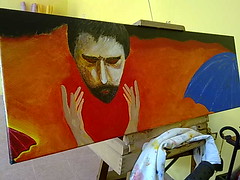
Roger Lipsey, The Spiritual in Twentieth Century Art
Picture: All Rights Reserved ® aml.2010
Saturday, May 15, 2010
social action
"But the explanation of how man should live a life of active social service in full harmony with himself as a member of the community of spirit, I found in the writings of those great medieval mystics [ Meister Eckhart and Jan van Ruysbroek ] for whom 'self-surrender' had been the way to self-realization, and who in 'singleness of mind' and 'inwardness' had found strength to say yes to every demand which the needs of their neighbours made them face, and to say yes also to every fate life had in store for them when they followed the call of duty as they understood it."
Dag Hammarskjold
The United Nations Meditation Room, Fresco by Bo Beskow, interior design by Wallace Harrison with participation by Dag Hammarskjold
Dag Hammarskjold
The United Nations Meditation Room, Fresco by Bo Beskow, interior design by Wallace Harrison with participation by Dag Hammarskjold
walk of life
"The contrast between the nearly obsolete expression walk of life and the modern word career captures much of what needs to be said about the relation between the studio and the marketplace. Walk of life implies a deliberate pace, as if one takes time to enjoy and record the landscape through which one is passing. One can arrive anywhere by walking, although it takes more time than careening. One arrives later, one arrives mature.
Career, on the other hand, at least today implies a nervous, outwardly directed endeavour that tests one's powers but may also abuse them and leave little time for them to develop into deep coherence.
Walk of life can be, although often it is not, the inner aspect of career. Similarly, career can be the outer aspect of walk of life; it assures the worldly progress - the personal connections, material opportunities, and social acceptance - of a professional life. Today, and in any era that thrusts art into a competitive marketplace, the artist must find a delicate balance. There is nothing wrong with a career, but it is empty and sometimes corrupting if it lacks the contemplative pace of a walk of life."
Roger Lipsey, The Spiritual in Twentieth Century Art

Career, on the other hand, at least today implies a nervous, outwardly directed endeavour that tests one's powers but may also abuse them and leave little time for them to develop into deep coherence.
Walk of life can be, although often it is not, the inner aspect of career. Similarly, career can be the outer aspect of walk of life; it assures the worldly progress - the personal connections, material opportunities, and social acceptance - of a professional life. Today, and in any era that thrusts art into a competitive marketplace, the artist must find a delicate balance. There is nothing wrong with a career, but it is empty and sometimes corrupting if it lacks the contemplative pace of a walk of life."
Roger Lipsey, The Spiritual in Twentieth Century Art
Tuesday, May 11, 2010
look within
Nobody understands what i mean.
Only a poet could begin to understand.
Carl Jung
Picture: All Rights Reserved ® aml.2010

Only a poet could begin to understand.
Carl Jung
Picture: All Rights Reserved ® aml.2010
Thursday, May 06, 2010
buddha nature and karma
"The physical body depends on karma for its existence and has no nature of its own, just as a wave depends on karma for its existence and has no nature of its own. The sea is one, while waves are countless. Noble sons and daughters are also like this. There is only one sea of our buddha nature. But when people are confused, the sea of buddha nature becomes the sea of consciousness, and the sea of consciousness becomes the sea of passion, and the sea of passion becomes the sea of karma, and the sea of karma becomes the sea of suffering, and from the sea of suffering, they receive countless, limitless karmic bodies. Thus, on top of confusion, they pile up confusion without end and without limit. But all those illusions can't compare to the one reality, namely, the true form of all dharmas."
Taken from: The Diamond Sutra by Red Pine
Taken from: The Diamond Sutra by Red Pine
Wednesday, May 05, 2010

Saturday, May 01, 2010
Viva la revolution...!!!
Had to blog this beautiful picture by Denis Collette at flickr. If i may quote him:
Viva la revolution...!!!
In fact, Nietzsche was right: "Creating is the great way to put an end to the suffering… is what makes life lightly”. Everything that interests me in this approach is that deep joy ... this inner need that makes me feel so alive ... it added a little something to the extraordinary beauty of this so creative Nature... so why should I be concerned about the distribution, sales or thieves of these images ... is the wild flower worried about the distribution or sale of the image that has taken of her? So like the wild flower, my images, once created, are no more mine... they belong to the world.
His other photos on flickr: Denis Collette @ Flickr
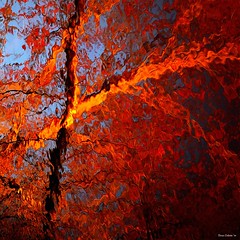
Viva la revolution...!!!
In fact, Nietzsche was right: "Creating is the great way to put an end to the suffering… is what makes life lightly”. Everything that interests me in this approach is that deep joy ... this inner need that makes me feel so alive ... it added a little something to the extraordinary beauty of this so creative Nature... so why should I be concerned about the distribution, sales or thieves of these images ... is the wild flower worried about the distribution or sale of the image that has taken of her? So like the wild flower, my images, once created, are no more mine... they belong to the world.
His other photos on flickr: Denis Collette @ Flickr
Tuesday, April 20, 2010
the spiritual in art
"Every work of art is the child of his age, and in many cases, the mother of our emotions."
Wassily Kandinsky
Monday, April 19, 2010
art and spirituality
The Spiritual in Twentieth Century Art by Roger Lipsey
Images, like words, are vehicles of consciousness; they allow us to think silently."
Roger Lipsey
Preview at Google Books
Images, like words, are vehicles of consciousness; they allow us to think silently."
Roger Lipsey
Preview at Google Books
Thursday, April 15, 2010
opposite of
The opposite of love is not hate, it's indifference.
The opposite of art is not ugliness, it's indifference.
The opposite of faith is not heresy, it's indifference.
And the opposite of life is not death, it's indifference.
Elie Wiesel
The opposite of art is not ugliness, it's indifference.
The opposite of faith is not heresy, it's indifference.
And the opposite of life is not death, it's indifference.
Elie Wiesel
Wednesday, April 14, 2010
Tuesday, April 13, 2010

Monday, April 12, 2010
loneliness
Loneliness does not come from having no people about one,
but from being unable to communicate the things that seem
important to oneself, or from holding certain views
which others find inadmissible.
Carl Jung
but from being unable to communicate the things that seem
important to oneself, or from holding certain views
which others find inadmissible.
Carl Jung
Saturday, April 10, 2010
Buddhism - religion? Or not
If we want to be free of the pain we inflict on ourselves and each other -- in other words, if we want to be happy -- then we have to learn to think for ourselves.
Although he was a prince born into a wealthy and powerful family, the young Siddhartha often just wanted to get away from it all. He wanted the space to think independently about who he was and what the spiritual path was about. Such freethinking was important to the Buddha's search for inner truth and his ultimate realization of enlightenment. These days more and more people in the West are following the teachings and example of the Buddha. But what are these teachings about? What is Buddhism? It looks like a religion, but is it?
Those teachings today still describe a deeply personal inner journey that's spiritual, yes, but not religious. The Buddha wasn't a god -- he wasn't even a Buddhist. You're not required to have more faith in the Buddha than you do in yourself. His power lies in his teachings, which show us how to work with our minds to realize our full capacity for wakefulness and happiness. These teachings can help us satisfy our search for the truth -- our need to know who and what we really are.
Where do we find this truth? Although we can rely to some degree on the wisdom we find in books and on the advice of respected spiritual authorities, that's only the beginning. The journey to genuine truth begins when you discover a true question -- one that comes from the heart -- from your own life and experience. That question will lead to an answer that will lead to another question, and so on. That's how it goes on the spiritual path.
We start by bringing an open, inquisitive, and skeptical mind to whatever we hear, read, or see that presents itself as the truth. We examine it with reason and we put it to the test in meditation and in our lives. As we gain insight into the workings of the mind, we learn how to recognize and deal with our day-to-day experiences of thoughts and emotions. We uncover inaccurate and unhelpful habits of thinking and begin to correct them. Eventually we're able to overcome the confusion that makes it so hard to see the mind's naturally brilliant awareness. In this sense, the Buddha's teachings are a method of investigation, or a science of mind.
Religion, on the other hand, often provides us with answers to life's big questions from the start. We don't have to think about it too much. We learn what to think and believe and our job is to live up to that, not to question it. If we relate to the Buddha's teachings as final answers that don't need to be examined, then we're practicing Buddhism as a religion.
Full article by Dzogchen Ponlop Rinpoche at Buddhist Channel
Although he was a prince born into a wealthy and powerful family, the young Siddhartha often just wanted to get away from it all. He wanted the space to think independently about who he was and what the spiritual path was about. Such freethinking was important to the Buddha's search for inner truth and his ultimate realization of enlightenment. These days more and more people in the West are following the teachings and example of the Buddha. But what are these teachings about? What is Buddhism? It looks like a religion, but is it?
Those teachings today still describe a deeply personal inner journey that's spiritual, yes, but not religious. The Buddha wasn't a god -- he wasn't even a Buddhist. You're not required to have more faith in the Buddha than you do in yourself. His power lies in his teachings, which show us how to work with our minds to realize our full capacity for wakefulness and happiness. These teachings can help us satisfy our search for the truth -- our need to know who and what we really are.
Where do we find this truth? Although we can rely to some degree on the wisdom we find in books and on the advice of respected spiritual authorities, that's only the beginning. The journey to genuine truth begins when you discover a true question -- one that comes from the heart -- from your own life and experience. That question will lead to an answer that will lead to another question, and so on. That's how it goes on the spiritual path.
We start by bringing an open, inquisitive, and skeptical mind to whatever we hear, read, or see that presents itself as the truth. We examine it with reason and we put it to the test in meditation and in our lives. As we gain insight into the workings of the mind, we learn how to recognize and deal with our day-to-day experiences of thoughts and emotions. We uncover inaccurate and unhelpful habits of thinking and begin to correct them. Eventually we're able to overcome the confusion that makes it so hard to see the mind's naturally brilliant awareness. In this sense, the Buddha's teachings are a method of investigation, or a science of mind.
Religion, on the other hand, often provides us with answers to life's big questions from the start. We don't have to think about it too much. We learn what to think and believe and our job is to live up to that, not to question it. If we relate to the Buddha's teachings as final answers that don't need to be examined, then we're practicing Buddhism as a religion.
Full article by Dzogchen Ponlop Rinpoche at Buddhist Channel
Thursday, April 08, 2010

Wednesday, April 07, 2010
qualities of the mind
Throughout its history, Buddhism has worked as a civilizing force. Its teachings on karma, for instance — the principle that all intentional actions have consequences — have taught morality and compassion to many societies. But on a deeper level, Buddhism has always straddled the line between civilization and wilderness. The Buddha himself gained Awakening in a forest, gave his first sermon in a forest, and passed away in a forest. The qualities of mind he needed in order to survive physically and mentally as he went, unarmed, into the wilds, were key to his discovery of the Dhamma. They included resilience, resolve, and alertness; self-honesty and circumspection; steadfastness in the face of loneliness; courage and ingenuity in the face of external dangers; compassion and respect for the other inhabitants of the forest. These qualities formed the "home culture" of the Dhamma.
Thanissaro Bhikkhu
The Customs of the Noble Ones
Thanissaro Bhikkhu
The Customs of the Noble Ones
Subscribe to:
Posts (Atom)