While many are seeking to climb the material ladder in life, others have reached the upper rungs and found out it's not all it's cracked up to be; choosing to set a different course - downshifting.
Even if you haven't reached (what is generally considered) the upper rungs to discover this, if you're struggling in this economic climate to keep up with all the "gotta haves" that perhaps you really don't need; step back, take a deep breath, separate from the pack and consider downshifting. The environment will certainly benefit from you doing so.
Downshifting, a term currently used most often in Australia and the UK, is the concept of living in voluntary simplicity; usually with environmental sustainability in mind although not necessarily the focus or primary motivator. People who take the downshifting route are also called "post materialists".
While some have been making these changes for years, it's only relatively recently that downshifting has acquired the label. An Australian Institute survey in 2004 found that nearly a quarter of Australian adults aged 30-59 have chosen to downshift over the previous 10 years.
People downshift their lives for mainly 5 reasons:
a) A desire for a more balanced life with less stress
b) Clashes between personal values and those of the workplace
c) Wanting a more fulfilling life
d) Ill health
e) Environmental concerns/rejection of consumerism
Continue reading here
Monday, August 09, 2010


Tuesday, August 03, 2010
Saturday, July 31, 2010
Inception
The 'Inception' of Illusion or Reality?
by Shen Shi'an, The Buddhist Channel, Jul 30, 2010
Singapore -- The ingenious film that is ‘Inception’ begins with the assumption that it is possible for multiple persons to enter someone’s dream, that can even be designed without that person knowing, thus digging out deep secrets from his sub-consciousness, or even implanting ideas which eventually shape one’s decisions.
Thank goodness this doesn’t seem technologically viable at the moment… though it does seem possible in the near future? If so, may this movie be a cautionary tale for what may come to be! This is especially relevant in this information age, when the conceiving of the slightest ideas by the powerful can mushroom into world-changing actions.
In the story, dreams are elaborately crafted by architects who have an eye for detail and creativity – so as to trick the dreamer into believing the dream sequences to be real. This reminds me of the Buddha’s teaching in the Diamond Sutra, that all conditioned phenomena (including real life) is dream-like, due to their ethereal and transient nature.
Even more confounding yet rich than the Matrix movies, the dream hackers are able to delve deeper into the subject’s mind by conjuring a dream… within a dream… within a dream! With intriguing cross-interaction over layers of dreams, even the hackers are at times unsure of whether they are still in a dream, which, and whose!
Continue reading here
by Shen Shi'an, The Buddhist Channel, Jul 30, 2010
Singapore -- The ingenious film that is ‘Inception’ begins with the assumption that it is possible for multiple persons to enter someone’s dream, that can even be designed without that person knowing, thus digging out deep secrets from his sub-consciousness, or even implanting ideas which eventually shape one’s decisions.
Thank goodness this doesn’t seem technologically viable at the moment… though it does seem possible in the near future? If so, may this movie be a cautionary tale for what may come to be! This is especially relevant in this information age, when the conceiving of the slightest ideas by the powerful can mushroom into world-changing actions.
In the story, dreams are elaborately crafted by architects who have an eye for detail and creativity – so as to trick the dreamer into believing the dream sequences to be real. This reminds me of the Buddha’s teaching in the Diamond Sutra, that all conditioned phenomena (including real life) is dream-like, due to their ethereal and transient nature.
Even more confounding yet rich than the Matrix movies, the dream hackers are able to delve deeper into the subject’s mind by conjuring a dream… within a dream… within a dream! With intriguing cross-interaction over layers of dreams, even the hackers are at times unsure of whether they are still in a dream, which, and whose!
Continue reading here
Shantideva's Guide to the Bodhisattva Way of Life
Day one of a three day teaching by His Holiness the Dalai Lama on Shantideva's "Guide to a Bodhisattva's Way of Life" given in New Delhi, India, from March 19-21, 2010. (www.dalailama.com)
Day two
Day three
Friday, July 30, 2010
nature of the mind
His Holiness the Dalai lama talks on the "Nature of the Mind" at the University of California Santa Barbara Events Center on April 24th, 2009. (www.dalailama.com)
Tuesday, July 27, 2010
Towards an integral model of Buddhism - Bhikkhu Bodhi
This lecture was given to the board members and volunteers of Buddhist Global Relief during a Board Retreat. It is an early attempt by Ven. Bodhi to develop a model for understanding and practicing Buddhism suitable for the post-modern stage of mind's evolution. The lecture was given on April 10th, 2010 at Bodhi Monastery in Lafayette, NJ
Buddhist Global Relief
Sunday, July 25, 2010
Rodney Smith
Interview with Rodney Smith:
Rodney Smith lives in Seattle, Washington, where he has been running a hospice. He has also set up hospices in Texas and Massachusetts, and teaches workshops nationwide on working with death and the dying. He has been offering vipassana retreats at IMS for many years, and has recently completed a book called Lessons from the Dying, to be published by Wisdom Publications.
Read interview here
Also, a book by Rodney Smith - Stepping out of self-deception at Amazon
Or you can find a preview of the book at Google Books.
Highly recommended.
Rodney Smith lives in Seattle, Washington, where he has been running a hospice. He has also set up hospices in Texas and Massachusetts, and teaches workshops nationwide on working with death and the dying. He has been offering vipassana retreats at IMS for many years, and has recently completed a book called Lessons from the Dying, to be published by Wisdom Publications.
Read interview here
Also, a book by Rodney Smith - Stepping out of self-deception at Amazon
Or you can find a preview of the book at Google Books.
Highly recommended.
Wednesday, July 21, 2010
questions
We do not know in advance what are the questions to ask,
and we often do not find out until we are close to the answer.
Steven Weinberg
and we often do not find out until we are close to the answer.
Steven Weinberg
Tuesday, July 13, 2010
Wisdom: From philosophy to neuroscience
Wisdom: From philosophy to neuroscience by Stephen Hall
examines ancient concepts of wisdom through the lens of modern brain science.
In a section called “Eight Neural Pillars of Wisdom,” Hall takes a fresh look at human qualities long associated with wisdom–including compassion, emotional regulation, the ability to discern what’s important, and the skill of coping with uncertainty–and suggests that modern neuroscience is providing radical new insights about how these timeless virtues evolved.
Based in part on a 2007 article in The New York Times Magazine, Wisdom is also a meditation on the seeds of wisdom, aspects of wisdom in everyday life, and the future of wisdom in our complex society.
examines ancient concepts of wisdom through the lens of modern brain science.
In a section called “Eight Neural Pillars of Wisdom,” Hall takes a fresh look at human qualities long associated with wisdom–including compassion, emotional regulation, the ability to discern what’s important, and the skill of coping with uncertainty–and suggests that modern neuroscience is providing radical new insights about how these timeless virtues evolved.
Based in part on a 2007 article in The New York Times Magazine, Wisdom is also a meditation on the seeds of wisdom, aspects of wisdom in everyday life, and the future of wisdom in our complex society.
Friday, July 09, 2010
Monday, July 05, 2010
Friday, July 02, 2010
Thursday, July 01, 2010
Dalai Lama on spiritual harmony
Speaking at the event, His Holiness said this spiritual gathering of Buddhist devotees - among them 400 Koreans, 300 Mongolians, 300 Chinese, and hundreds of Japanese - reflects the widespread propagation of Buddha’s teachings in Asia. He said he was optimistic about the prospects for a more peaceful and non-violent world as a small but significant group of people are now focussing their attention and energy on developing secular ethics of compassion, peace, love and kindness.
These secular ethics have the possibility of promoting a happy and healthy life for believers as well as non-believers. However, many see these secular ethics as religious and hence ignore them but His Holiness said compassion is biologically inherent in all living beings, animals as well as humans, in that everyone needs love and kindness for a happy, wholesome life. “There are many non-believers who are also great human beings,” he added.
Secularism, His Holiness said, is misunderstood by some religious practitioners as rejection of religion which is not true. In the current reality, secularism means respect not only for all religions but respect also for non-believers.
Read the article here
These secular ethics have the possibility of promoting a happy and healthy life for believers as well as non-believers. However, many see these secular ethics as religious and hence ignore them but His Holiness said compassion is biologically inherent in all living beings, animals as well as humans, in that everyone needs love and kindness for a happy, wholesome life. “There are many non-believers who are also great human beings,” he added.
Secularism, His Holiness said, is misunderstood by some religious practitioners as rejection of religion which is not true. In the current reality, secularism means respect not only for all religions but respect also for non-believers.
Read the article here
Wednesday, June 23, 2010
Mind and Life XIV Day 1
Morning session:
Afternoon session:
Double click on the video to goto youtube's website to access follow-up videos for the next 4 days.
Afternoon session:
Double click on the video to goto youtube's website to access follow-up videos for the next 4 days.
Thursday, June 17, 2010
The Ego Tunnel - The Science of the Mind and the Myth of the Self
Review - The Ego Tunnel
The Science of the Mind and the Myth of the Self
by Thomas Metzinger
Basic Books, 2009
Review by Kamuran Godelek, Ph.D.
Oct 6th 2009 (Volume 13, Issue 41
by Thomas Metzinger
Basic Books, 2009
Review by Kamuran Godelek, Ph.D.
Oct 6th 2009 (Volume 13, Issue 41)
Read the review here
The Science of the Mind and the Myth of the Self
by Thomas Metzinger
Basic Books, 2009
Review by Kamuran Godelek, Ph.D.
Oct 6th 2009 (Volume 13, Issue 41
by Thomas Metzinger
Basic Books, 2009
Review by Kamuran Godelek, Ph.D.
Oct 6th 2009 (Volume 13, Issue 41)
Read the review here
Wednesday, May 26, 2010
Tuesday, May 18, 2010
working on self
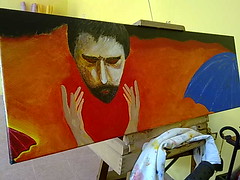
Craftspeople often grasp that the stages through which a work must pass to reach completion parallel the maturation of the human being and so shed light on our own needs and possibilities. It follows by analogy that to study a craft is to study one's own nature; hence the firm association between craft work and the search for self-knowledge. This is the faith underlying some craft traditions that preserve a key reflexive: not only "I work" but also "I work on myself."
Roger Lipsey, The Spiritual in Twentieth Century Art
Picture: All Rights Reserved ® aml.2010
Roger Lipsey, The Spiritual in Twentieth Century Art
Picture: All Rights Reserved ® aml.2010
Saturday, May 15, 2010
social action
"But the explanation of how man should live a life of active social service in full harmony with himself as a member of the community of spirit, I found in the writings of those great medieval mystics [ Meister Eckhart and Jan van Ruysbroek ] for whom 'self-surrender' had been the way to self-realization, and who in 'singleness of mind' and 'inwardness' had found strength to say yes to every demand which the needs of their neighbours made them face, and to say yes also to every fate life had in store for them when they followed the call of duty as they understood it."
Dag Hammarskjold
The United Nations Meditation Room, Fresco by Bo Beskow, interior design by Wallace Harrison with participation by Dag Hammarskjold
Dag Hammarskjold
The United Nations Meditation Room, Fresco by Bo Beskow, interior design by Wallace Harrison with participation by Dag Hammarskjold
walk of life
"The contrast between the nearly obsolete expression walk of life and the modern word career captures much of what needs to be said about the relation between the studio and the marketplace. Walk of life implies a deliberate pace, as if one takes time to enjoy and record the landscape through which one is passing. One can arrive anywhere by walking, although it takes more time than careening. One arrives later, one arrives mature.
Career, on the other hand, at least today implies a nervous, outwardly directed endeavour that tests one's powers but may also abuse them and leave little time for them to develop into deep coherence.
Walk of life can be, although often it is not, the inner aspect of career. Similarly, career can be the outer aspect of walk of life; it assures the worldly progress - the personal connections, material opportunities, and social acceptance - of a professional life. Today, and in any era that thrusts art into a competitive marketplace, the artist must find a delicate balance. There is nothing wrong with a career, but it is empty and sometimes corrupting if it lacks the contemplative pace of a walk of life."
Roger Lipsey, The Spiritual in Twentieth Century Art

Career, on the other hand, at least today implies a nervous, outwardly directed endeavour that tests one's powers but may also abuse them and leave little time for them to develop into deep coherence.
Walk of life can be, although often it is not, the inner aspect of career. Similarly, career can be the outer aspect of walk of life; it assures the worldly progress - the personal connections, material opportunities, and social acceptance - of a professional life. Today, and in any era that thrusts art into a competitive marketplace, the artist must find a delicate balance. There is nothing wrong with a career, but it is empty and sometimes corrupting if it lacks the contemplative pace of a walk of life."
Roger Lipsey, The Spiritual in Twentieth Century Art
Tuesday, May 11, 2010
look within
Nobody understands what i mean.
Only a poet could begin to understand.
Carl Jung
Picture: All Rights Reserved ® aml.2010

Only a poet could begin to understand.
Carl Jung
Picture: All Rights Reserved ® aml.2010
Thursday, May 06, 2010
buddha nature and karma
"The physical body depends on karma for its existence and has no nature of its own, just as a wave depends on karma for its existence and has no nature of its own. The sea is one, while waves are countless. Noble sons and daughters are also like this. There is only one sea of our buddha nature. But when people are confused, the sea of buddha nature becomes the sea of consciousness, and the sea of consciousness becomes the sea of passion, and the sea of passion becomes the sea of karma, and the sea of karma becomes the sea of suffering, and from the sea of suffering, they receive countless, limitless karmic bodies. Thus, on top of confusion, they pile up confusion without end and without limit. But all those illusions can't compare to the one reality, namely, the true form of all dharmas."
Taken from: The Diamond Sutra by Red Pine
Taken from: The Diamond Sutra by Red Pine
Wednesday, May 05, 2010

Saturday, May 01, 2010
Viva la revolution...!!!
Had to blog this beautiful picture by Denis Collette at flickr. If i may quote him:
Viva la revolution...!!!
In fact, Nietzsche was right: "Creating is the great way to put an end to the suffering… is what makes life lightly”. Everything that interests me in this approach is that deep joy ... this inner need that makes me feel so alive ... it added a little something to the extraordinary beauty of this so creative Nature... so why should I be concerned about the distribution, sales or thieves of these images ... is the wild flower worried about the distribution or sale of the image that has taken of her? So like the wild flower, my images, once created, are no more mine... they belong to the world.
His other photos on flickr: Denis Collette @ Flickr

Viva la revolution...!!!
In fact, Nietzsche was right: "Creating is the great way to put an end to the suffering… is what makes life lightly”. Everything that interests me in this approach is that deep joy ... this inner need that makes me feel so alive ... it added a little something to the extraordinary beauty of this so creative Nature... so why should I be concerned about the distribution, sales or thieves of these images ... is the wild flower worried about the distribution or sale of the image that has taken of her? So like the wild flower, my images, once created, are no more mine... they belong to the world.
His other photos on flickr: Denis Collette @ Flickr
Tuesday, April 20, 2010
the spiritual in art
"Every work of art is the child of his age, and in many cases, the mother of our emotions."
Wassily Kandinsky
Monday, April 19, 2010
art and spirituality
The Spiritual in Twentieth Century Art by Roger Lipsey
Images, like words, are vehicles of consciousness; they allow us to think silently."
Roger Lipsey
Preview at Google Books
Images, like words, are vehicles of consciousness; they allow us to think silently."
Roger Lipsey
Preview at Google Books
Thursday, April 15, 2010
opposite of
The opposite of love is not hate, it's indifference.
The opposite of art is not ugliness, it's indifference.
The opposite of faith is not heresy, it's indifference.
And the opposite of life is not death, it's indifference.
Elie Wiesel
The opposite of art is not ugliness, it's indifference.
The opposite of faith is not heresy, it's indifference.
And the opposite of life is not death, it's indifference.
Elie Wiesel
Wednesday, April 14, 2010
Tuesday, April 13, 2010

Monday, April 12, 2010
loneliness
Loneliness does not come from having no people about one,
but from being unable to communicate the things that seem
important to oneself, or from holding certain views
which others find inadmissible.
Carl Jung
but from being unable to communicate the things that seem
important to oneself, or from holding certain views
which others find inadmissible.
Carl Jung
Saturday, April 10, 2010
Buddhism - religion? Or not
If we want to be free of the pain we inflict on ourselves and each other -- in other words, if we want to be happy -- then we have to learn to think for ourselves.
Although he was a prince born into a wealthy and powerful family, the young Siddhartha often just wanted to get away from it all. He wanted the space to think independently about who he was and what the spiritual path was about. Such freethinking was important to the Buddha's search for inner truth and his ultimate realization of enlightenment. These days more and more people in the West are following the teachings and example of the Buddha. But what are these teachings about? What is Buddhism? It looks like a religion, but is it?
Those teachings today still describe a deeply personal inner journey that's spiritual, yes, but not religious. The Buddha wasn't a god -- he wasn't even a Buddhist. You're not required to have more faith in the Buddha than you do in yourself. His power lies in his teachings, which show us how to work with our minds to realize our full capacity for wakefulness and happiness. These teachings can help us satisfy our search for the truth -- our need to know who and what we really are.
Where do we find this truth? Although we can rely to some degree on the wisdom we find in books and on the advice of respected spiritual authorities, that's only the beginning. The journey to genuine truth begins when you discover a true question -- one that comes from the heart -- from your own life and experience. That question will lead to an answer that will lead to another question, and so on. That's how it goes on the spiritual path.
We start by bringing an open, inquisitive, and skeptical mind to whatever we hear, read, or see that presents itself as the truth. We examine it with reason and we put it to the test in meditation and in our lives. As we gain insight into the workings of the mind, we learn how to recognize and deal with our day-to-day experiences of thoughts and emotions. We uncover inaccurate and unhelpful habits of thinking and begin to correct them. Eventually we're able to overcome the confusion that makes it so hard to see the mind's naturally brilliant awareness. In this sense, the Buddha's teachings are a method of investigation, or a science of mind.
Religion, on the other hand, often provides us with answers to life's big questions from the start. We don't have to think about it too much. We learn what to think and believe and our job is to live up to that, not to question it. If we relate to the Buddha's teachings as final answers that don't need to be examined, then we're practicing Buddhism as a religion.
Full article by Dzogchen Ponlop Rinpoche at Buddhist Channel
Although he was a prince born into a wealthy and powerful family, the young Siddhartha often just wanted to get away from it all. He wanted the space to think independently about who he was and what the spiritual path was about. Such freethinking was important to the Buddha's search for inner truth and his ultimate realization of enlightenment. These days more and more people in the West are following the teachings and example of the Buddha. But what are these teachings about? What is Buddhism? It looks like a religion, but is it?
Those teachings today still describe a deeply personal inner journey that's spiritual, yes, but not religious. The Buddha wasn't a god -- he wasn't even a Buddhist. You're not required to have more faith in the Buddha than you do in yourself. His power lies in his teachings, which show us how to work with our minds to realize our full capacity for wakefulness and happiness. These teachings can help us satisfy our search for the truth -- our need to know who and what we really are.
Where do we find this truth? Although we can rely to some degree on the wisdom we find in books and on the advice of respected spiritual authorities, that's only the beginning. The journey to genuine truth begins when you discover a true question -- one that comes from the heart -- from your own life and experience. That question will lead to an answer that will lead to another question, and so on. That's how it goes on the spiritual path.
We start by bringing an open, inquisitive, and skeptical mind to whatever we hear, read, or see that presents itself as the truth. We examine it with reason and we put it to the test in meditation and in our lives. As we gain insight into the workings of the mind, we learn how to recognize and deal with our day-to-day experiences of thoughts and emotions. We uncover inaccurate and unhelpful habits of thinking and begin to correct them. Eventually we're able to overcome the confusion that makes it so hard to see the mind's naturally brilliant awareness. In this sense, the Buddha's teachings are a method of investigation, or a science of mind.
Religion, on the other hand, often provides us with answers to life's big questions from the start. We don't have to think about it too much. We learn what to think and believe and our job is to live up to that, not to question it. If we relate to the Buddha's teachings as final answers that don't need to be examined, then we're practicing Buddhism as a religion.
Full article by Dzogchen Ponlop Rinpoche at Buddhist Channel
Thursday, April 08, 2010

Wednesday, April 07, 2010
qualities of the mind
Throughout its history, Buddhism has worked as a civilizing force. Its teachings on karma, for instance — the principle that all intentional actions have consequences — have taught morality and compassion to many societies. But on a deeper level, Buddhism has always straddled the line between civilization and wilderness. The Buddha himself gained Awakening in a forest, gave his first sermon in a forest, and passed away in a forest. The qualities of mind he needed in order to survive physically and mentally as he went, unarmed, into the wilds, were key to his discovery of the Dhamma. They included resilience, resolve, and alertness; self-honesty and circumspection; steadfastness in the face of loneliness; courage and ingenuity in the face of external dangers; compassion and respect for the other inhabitants of the forest. These qualities formed the "home culture" of the Dhamma.
Thanissaro Bhikkhu
The Customs of the Noble Ones
Thanissaro Bhikkhu
The Customs of the Noble Ones
Monday, April 05, 2010
going forth - Pabbajja

True holiness is never born without solitude;
never is it perfected without struggle with the passions within.
Going Forth - A call to Buddhist monkhood by Sumana Samanera
Picture: All Rights Reserved ® aml.2009
stirred

"I know not, Ananda, even of a single form whereby pleasure and satisfaction in form does not pass into sorrow and lamentation, pain, grief, despair, since it is transient and changeable. This world, however, seeks pleasure, loves pleasure, prizes pleasure. Only a few beings are stirred by things that are truly stirring, in comparison with the greater number who remain unstirred by truly stirring things. And again, there are only a few who, being stirred, earnestly strive, in comparison with the greater number who, being stirred, yet do not earnestly strive."
Gautama
Picture: All Rights Reserved ® aml.2010
Saturday, March 27, 2010
present moment

Were you to live three thousand years, or even thirty thousand,
remember that the sole life which a man can lose
is that which he is living at the moment.
This means that the longest life and the shortest life
amount to the same thing. For the passing minute
is every man's equal possession, but what has once gone by is not ours.
For the sole thing of which any man can be deprived
is the present; since this is all he owns.
Marcus Aurelius
limits

One becomes sharply aware, but without regret,
the limits of mutual understanding and consonance.
Albert Einstein, Ideas and Opinions
Thursday, March 25, 2010
clinging

...clinging is suffering. It's because of clinging that physical pain becomes mental pain. It's because of clinging that aging, illness, and death cause mental distress. The paradox here is that, in clinging to things, we don't trap them or get them under our control. Instead, we trap ourselves.
Thanissaro Bhikkhu
Sunday, March 21, 2010
Wednesday, March 17, 2010
non-duality
When you can neither speak nor talk of any event,
when you neither indicate nor 'know' any thing,
when you pass beyond both questions and answers,
this is entering the gate of non-duality.
Manjusri, Vimalakirti Sutra
when you neither indicate nor 'know' any thing,
when you pass beyond both questions and answers,
this is entering the gate of non-duality.
Manjusri, Vimalakirti Sutra
Monday, March 15, 2010
gateway to the dharma

The Master begins by revealing the boundless temporal and spatial dimensions
against which the quest for enlightenment unfolds. He then swiftly narrows down
the focus of his attention to the prospective student’s own situation in the here and
now. His concern is not with theory but with attitudes and actions. Repeatedly, he
drives home the point that our purpose in studying the Dharma should not be the mere
acquiring of information, however interesting, but the transformation and purification
of our minds. Though he ultimately steers us towards the broad bodhisattva
path aimed at benefiting all sentient beings, he does not let us escape the “narrow
path” with its hard tasks of self-scrutiny, self-rectification, and self-cultivation.
Alertness, heedfulness, conscientiousness, and integrity are the watchwords of this
training. The path he guides us towards is never an easy one, but it is one that
brings abundant rewards. It enables us to master the conditions of life instead of
drifting along with them; it helps us ride over the high waves of good fortune without
being dashed by the tidal waves of calamity. It teaches us how to dwell like a
mountain, ever tall, strong, and steady, unswayed even by the roughest winds.
Extract from Foreword by Ven. Bhikkhu Bodhi
To read: Gateway to the Dharma by Venerable Master Jen-Chun
Sunday, March 14, 2010
true happiness

It's important to reflect on what true happiness is and where it can be found. A moment's reflection will show that you can't find it in the past or the future. The past is gone and your memory of it is undependable. The future is a blank uncertainty. So the only place we can really find happiness is in the present. But even here you have to know where to look. If you try to base your happiness on things that change — sights, sounds, sensations in general, people and things outside — you're setting yourself up for disappointment, like building your house on a cliff where there have been repeated landslides in the past. So true happiness has to be sought within. Meditation is thus like a treasure hunt: to find what has solid and unchanging worth in the mind, something that even death cannot touch.
Thanissaro Bhikkhu
Picture: All Rights Reserved ® aml.2010
Saturday, March 06, 2010
Thursday, March 04, 2010
third age

For age is opportunity no less
Than youth itself, though in another dress,
And as the evening twilight fades away
The sky is filled with stars, invisible by day.
Henry W. Longfellow
Picture: All Rights Reserved ® aml
Wednesday, March 03, 2010
solitude

"for those who walk the path of solitude."
Road to Heaven - Encounters with Chinese Hermits by Bill Porter
Friday, February 26, 2010
HH Dalai Lama - Ethics for our time
His Holiness the XIV Dalai Lama: Ethics for Our Time at UC Santa Barbara in April 2009.
HH Dalai Lama talks about cultivation of inner life - inner values and inner peace.
Thursday, February 25, 2010
meditation timer

A very useful meditation timer widget for mac users.
Download widget at apple website:
Meditation Timer
Wednesday, February 24, 2010
four determinations

One should not be negligent of discernment,
should guard the truth,
be devoted to relinquishment,
and train only for calm.
Majjhima Nikaya 140
Picture: All Rights reserved ® aml
Monday, February 22, 2010

Monday, February 15, 2010
the true believer

Our frustration is greater when we have much and want more than
when we have nothing and want some.
We are less dissatisfied when we lack many things than
when we seem to lack but one thing.
Eric Hoffer, The True Believer - Thoughts on the nature of mass movements
Friday, February 12, 2010
mind

Men are not prisoners of their own fate,
but only prisoners of their own mind.
Franklin Roosevelt
writing - Ted Solotaroff
"Writing itself, if not misunderstood and abused, becomes a way of empowering the writing self. It converts anger and disappointment into deliberate and durable aggression, the writer's main source of energy. It converts sorrow and self-pity into empathy, the writer's main means of relating to otherness. Similarly, his wounded innocence turns into irony, his silliness into wit, his guilt into judgment, his oddness into originality, his perverseness into his stinger."
Ted Solotaroff
Ted Solotaroff
Friday, February 05, 2010

Sunday, January 31, 2010

life for rent - dido
"Life For Rent" by Dido
I haven't ever really found a place that I call home
I never stick around quite long enough to make it
I apologize once again I'm not in love
But it's not as if I mind
that your heart ain't exactly breaking
It's just a thought, only a thought
But if my life is for rent and I don't learn to buy
Well I deserve nothing more than I get
Cos nothing I have is truly mine
I've always thought
that I would love to live by the sea
To travel the world alone
and live more simply
I have no idea what's happened to that dream
Cos there's really nothing left here to stop me
It's just a thought, only a thought
But if my life is for rent and I don't learn to buy
Well I deserve nothing more than I get
Cos nothing I have is truly mine
If my life is for rent and I don't learn to buy
Well I deserve nothing more than I get
Cos nothing I have is truly mine
While my heart is a shield and I won't let it down
While I am so afraid to fail so I won't even try
Well how can I say I'm alive
If my life is for rent and I don't learn to buy
Well I deserve nothing more than I get
Cos nothing I have is truly mine
If my life is for rent and I don't learn to buy
Well I deserve nothing more than I get
Cos nothing I have is truly mine
Cos nothing I have is truly mine
Cos nothing I have is truly mine
Cos nothing I have is truly mine
Friday, January 29, 2010
J. D. Salinger

From L.A TImes, written by David L. Ulin
And yet, our collective fascination with his life rather than his writing suggests another bit of code, or at least a set of clues. Wasn't this, after all, what Salinger was rejecting, a culture of celebrity in which the most important thing was appearance and no one cared about the level of the soul?
"I just quit, that's all," Franny Glass tells her boyfriend early in "Franny and Zooey," explaining why she gave up acting. " . . . I don't know. It seemed like such poor taste, sort of, to want to act in the first place. I mean all the ego. And I used to hate myself so, when I was in a play, to be backstage after the play was over. All those egos running around feeling terribly charitable and warm."
For all that "The Catcher in the Rye" made him famous, "Franny and Zooey" is Salinger's masterpiece, an evocation of loss and longing within the bonds of family. Composed of two novellas, it introduces the youngest members of the Glass family, about whom Salinger would devote more than half of his published work.
Read full article from LA Times here
Picture from Amazon.com
Friday, January 22, 2010

Monday, January 11, 2010
among my friends love is a great sorrow

Among my friends love is a great sorrow.
It has become a daily burden, a feast,
a gluttony for fools, a heart's famine.
We visit one another asking, telling one another.
We do not burn hotly, we question the fire.
We do not fall forward with our alive
eager faces looking thru into the fire.
We stare back into our faces.
We have become our own realities.
We seek to exhaust our lovelessness.
Among my friends love is a painful question.
We seek out among the passing faces
a sphinx-face who will ask its riddle.
Among my friends love is an answer to a question
that has not been asked.
Then ask it.
Among my friends love is a payment.
It is an old debt for a borrowing foolishly spent.
And we go on, borrowing and borrowing
from each other.
Among my friends love is a wage
that one might have for an honest living.
Robert Duncan
Sunday, January 10, 2010
jhana

Jhana is called the pleasure of renunciation,
the pleasure of seclusion,
the pleasure of peace,
the pleasure of enlightenment.
I say of this kind of pleasure that it should be pursued,
that it should be developed,
that it should be cultivated,
that it should not be feared.
Majjhima Nikaya 66
Picture: All Rights Reserved ® aml.2008
Tuesday, January 05, 2010
essence of holy life

This holy life is led not for gain honour and fame,
not for endowment of virtues, not for endowment of concentration,
and not for the endowment of knowledge and vision.
It is for the unshakeable release of mind.
This is the essence of the holy life,
it is the heartwood and the end of the holy life.
Majjhima Nikaya 30
Picture: All Rights Reserved ® aml.2009
Thursday, December 31, 2009
Wednesday, December 30, 2009
letting go

Judy Lief teaches us to walk through life without holding on. - From Tricycle
IN OUR FAST-PACED SOCIETY, letting go is often paired with moving on. People encourage friends who have suffered a loss to learn to let go of the past and get on with living. In New Age terminology, “just let go” has become an all-purpose piece of advice. But we humans are very cunning: While we talk a lot about letting go, we usually find a way to have our cake and eat it, too—to let go and still manage to hang on. In fact, it is easy to use the notion of letting go as yet another ego-tool. We can use it to prop ourselves up, to cloud things over, and uphold our illusion of solidity. We are so clever: we can take a concept like letting go, so threatening to our ego-fixation, and turn it completely on its head, so that instead it becomes a credential, an ego adornment. We can take pride in our letting go and revel in how pure we are now that we have pared down and simplified and become so much less materialistic. We can mask our laziness by seeing it instead as a letting go of ambition; we can mask our inability to connect with other people with the more spiritual notion of letting go of frivolous attachments. The possibilities are endless. So if we are to deepen our understanding of letting go, it is important to begin with an insight into how easily it can be distorted. Then we may be able to discriminate between a pretense of letting go and the real thing.
Continue reading here
Picture from Tricycle
Tuesday, December 29, 2009
alone

In the mountain, stillness surges up
to explore its own height;
in the lake, movement stands still
to contemplate its own depth.
R. Tagore, Fireflies
Saturday, December 26, 2009
Monday, December 21, 2009
i know i've loved you before
I've Loved You Before
When there's no one else
that makes me whole
i get this feeling
That i've loved you before.
Were we lovers in an army
marching all for Rome?
Side by side in battle
Did we bravely leave our home?
Did i hold you in my arms
As you were taking your last breath?
Did i shout to all the Gods
that i would love you beyond death?
Have i wondered through the desert?
Have i looked and learned all the stars?
Have i rode the days and nights
on rails to get back where you are?
And every time i floundered
It's your eyes i know for sure.
I know, i've loved you before
I've loved you before
Melissa Etheridge
When there's no one else
that makes me whole
i get this feeling
That i've loved you before.
Were we lovers in an army
marching all for Rome?
Side by side in battle
Did we bravely leave our home?
Did i hold you in my arms
As you were taking your last breath?
Did i shout to all the Gods
that i would love you beyond death?
Have i wondered through the desert?
Have i looked and learned all the stars?
Have i rode the days and nights
on rails to get back where you are?
And every time i floundered
It's your eyes i know for sure.
I know, i've loved you before
I've loved you before
Melissa Etheridge
Tuesday, December 15, 2009
troublesome mind

By Priya Devi R, OneIndia, Dec 14, 2009
New Delhi, India -- A Buddhist story about freeing oneself from the tyranny of thoughts, paving way for a silent mind. A short story about leading one from the mind to the no mind, a state of eternal peace. Gautama Buddha one day asked one of his disciples to beg alms from a certain household and report to him at dusk. The monk returned to the master as per his command only to let him know that he would not beg for alms in that particular house again. When pressed for the reason, the monk answered, " I savoured the delicious food served and I suddenly felt an urge to eat something sweet. The lady of the house offered me a sweet dish. I then felt like sleeping and the lady immediately asked me to rest for a while. I was surprised by her ability to read my thoughts that I asked how she knew of my desires?"
"The lady replied, 'Witnessing my thoughts, my mind has become silent now that I can now see other thoughts as well."
The monk continued to Buddha, " Looking at her I had sexual thoughts also and now I am embarrassed to see her again for alms as she would have read my sensual desire as well. So I do not want to visit her house for alms"
The Buddha said that the monk ought to go to the particular house for alms again. He advised, "This time you will go as a changed person. Just be aware of your thoughts, every bite of your food and every step that you take. You will just have to watch every thought that arises, but do not co-operate with it . Disassociate with it and do not analyze it. No thought is yours, they come from outside!"
The monk did as advised by Gautama Buddha. He remained a mere witness to his thoughts and there was no co-operation from his end. There was a change within him, an inner peace, though the world continued to remain the same.
The one and only trouble is one's own mind. When one knows one's true self, the mind ceases to be.
Taken from Buddhist Channel
Picture: All Rights Reserved ® aml.2008
Saturday, December 05, 2009
Ven. Dr. Yifa’s Response to the Bhikkhuni Ordination at Perth

Los Angeles, CA (USA) -- Thirty years ago, I visited a Buddhist monastery for the first time in my life. Two weeks later, I decided to shave my head and become a nun. At the time, I was a student at the law school of National Taiwan University, and wanted to be a lawyer or even a politician. I had felt, since I was a child, great sympathy toward the suppressed classes in society and was attracted to fairness and justice. These have been the guiding values in my life.
Continue reading at Buddhist Channel
Sunday, November 01, 2009
Saturday, October 24, 2009
becoming better

‘Things might not always become better,
but we can always become better,
and that can always make things better.’
Stonepeace
Picture: All Rights Reserved ® aml.2009
Monday, October 19, 2009
Saturday, October 17, 2009
Center for Investigating Healthy Minds
The Center for Investigating Healthy Minds is located within the Waisman Center at the University of Wisconsin-Madison, we are a research Center dedicated to creating a world in which healthy qualities of mind flourish. The Center for Investigating Healthy Minds, through hard-nosed basic and translational scientific research, will help to pave the way toward more widespread incorporation of methods and practices to nourish positive qualities of mind throughout society. The work and research of this Center is at the forefront of the scientific and scholarly communities, and has led to the development of a new hybrid discipline – contemplative neuroscience. In a global era where individuals, communities and the world are reconnecting with the pursuit of happiness, well-being and contentment and seeking innovative and mindful solutions to achieve it, the Center offers facts about interventions and methods grounded both in research and the wisdom of contemplative traditions.
The Center for Investigating Healthy Minds conducts rigorous interdisciplinary research on naturally occurring and cultivated positive qualities of mind such as kindness, compassion and focused attention. Although our core approach is neuroscientific, we examine every level of analysis from experience to molecular processes. The Center engages in local and global outreach and aims to become an authoritative source for scientific research on the healthy mind.
Center for Investigating Healthy Minds
The Center for Investigating Healthy Minds conducts rigorous interdisciplinary research on naturally occurring and cultivated positive qualities of mind such as kindness, compassion and focused attention. Although our core approach is neuroscientific, we examine every level of analysis from experience to molecular processes. The Center engages in local and global outreach and aims to become an authoritative source for scientific research on the healthy mind.
Center for Investigating Healthy Minds
Friday, September 25, 2009
nibbana
So this holy life, bhikkhus, does not have gain, honour, and renown for its benefit, or the attainment of virtue for its benefit, or the attainment of concentration for its benefit, or knowledge and vision for its benefit. But it is this unshakeable deliverance of mind that is the goal of this holy life, its heartwood, and its end.
Majjhima Nikaya
Majjhima Nikaya
Thursday, September 24, 2009
nibbana

Here, Ananda, having gone to the forest, to the foot of a tree or to an empty hut,
a monk reflects thus: “This is peaceful, this is sublime, that is, the stilling of all formations, the relinquishment
of all acquisitions, the destruction of craving, cessation, Nibbana.”
Anguttara Nikaya
Picture: All Rights Reserved ® aml.2008
Wednesday, September 23, 2009
measured by
“Bhikkhu, if one has an underlying tendency towards something, then one is measured in accordance with it; if one is measured in accordance with something, then one will be reckoned in terms of it. If one does not have an underlying tendency towards something, then one is not measured in accordance with it; if one is not measured in accordance with something, then one will not be reckoned in terms of it... If... one has an underlying tendency towards material form, feeling, perception, mental formations or consiousness then one will be measured in accordance with it; if one is measured in accordance with it, then one will be reckoned in terms of it. If one has no underlying tendency towards material form, feeling, perception, mental formations or consiousness then one will not be measured in accordance with it; if one is not measured in accordance with it, then one will not be reckoned in terms of it.”
Samyutta Nikaya
Samyutta Nikaya
Monday, September 21, 2009
atammayata

Atammayatæ is the utter abandonment of this root delusion: one sees that in ultimate truth there is no time, no self, no here and no there. So rather than “Be here now” as a spiritual exhortation, perhaps instead we should say: “Let go of identity, space and time,” or: “Realize unlocated, timeless selflessness.” Needless to say, the conceptual mind falls flat when trying to conjure up an image for such a reality but that is to be expected. We are consciously leaving the realm of the conceivable, and the purpose of this book is to provide something of a map for those regions where the buses of reason and imagination do not run.
It is also quite possible that, on reading these passages on Atammayatæ, the mind wants to grasp it as “some thing to get so that ‘I’ won’t be so deluded” rather than seeing it as a restraining of the habitual outward movement of the mind that comes as a
result of disenchantment and dispassion. It is always necessary to be aware of the way that ignorance causes even the means of transcendence to become an obstacle, if the mind does not handle it wisely.
This is to say that if, with mindfulness and wisdom, the tendency to ‘go out’ into perceptions, thoughts and emotions is restrained, and one just allows seeing to be seeing, hearing to be hearing etc., the whole papañca-drama does not get launched in the first place. The heart then rests at ease, open and clear; all perceptions conventionally labelled as ‘myself’ or ‘the world’ are seen as transparent, if convenient, fictions. When there is insufficient mindfulness and wisdom, the mind ‘goes out’ and attaches to its perceptions and moods, the result of which is the experience of ‘me being pressured by life.’ Both an apparently solid self and a solid world have been unconsciously created, and the friction between the two is the dukkha that
we find ourselves running from so regularly and ineffectively. Trying to find a ‘me’ without a world that burdens it is like trying to run away from our own shadow; no matter how hard we run, the effort is bound to fail as the one form generates
the other.
The aim of all these teachings on Atammayatæ is to show us that the dualities of subject and object (‘me and the world’), do not have to be brought into being at all. And when the heart is restrained from ‘going out,’ and awakens to its fundamental
nature, a bright and joyful peace is what remains. This is the peace of Nibbæna.
The Island, Ajahn Pasanno & Ajahn Amaro
Abhayagiri Monastery
Saturday, September 19, 2009
Ajahn Chah - no abiding

“The worldly way is to do things for a reason, to get some return, but in Buddhism we do things without any gaining idea. The
world has to understand things in terms of cause and effect, but the Buddha teaches us to go above and beyond cause and effect. His wisdom was to go above cause, beyond effect; to go above birth and beyond death; to go above happiness and beyond suffering.
Think about it: there’s nowhere to stay. We people live in a home. To leave home and go where there is no home – we don’t know
how to do that, because we’ve always lived with becoming, with clinging. If we can’t cling we don’t know what to do.”
Ajahn Chah, ‘No Abiding,’ in ‘Food for the Heart,’
Friday, September 18, 2009
no self or not-self?

One of the first stumbling blocks that Westerners often encounter when they learn about Buddhism is the teaching on anatta, often translated as no-self. This teaching is a stumbling block for two reasons. First, the idea of there being no self doesn't fit well with other Buddhist teachings, such as the doctrine of kamma and rebirth: If there's no self, what experiences the results of kamma and takes rebirth? Second, it doesn't fit well with our own Judeo-Christian background, which assumes the existence of an eternal soul or self as a basic presupposition: If there's no self, what's the purpose of a spiritual life? Many books try to answer these questions, but if you look at the Pali canon — the earliest extant record of the Buddha's teachings — you won't find them addressed at all. In fact, the one place where the Buddha was asked point-blank whether or not there was a self, he refused to answer. When later asked why, he said that to hold either that there is a self or that there is no self is to fall into extreme forms of wrong view that make the path of Buddhist practice impossible. Thus the question should be put aside. To understand what his silence on this question says about the meaning of anatta, we first have to look at his teachings on how questions should be asked and answered, and how to interpret his answers.
Read more...
Noble Strategy, Thanissaro Bhikkhu
Thursday, September 10, 2009
The Island - Buddha's teachings on Nibbana

Read latest publication: The Island - An Anthology on Buddha's Teachings on Nibbana by Ajahn Pasanno and Ajahn Amaro
The Island by Ajahn Pasanno and Ajahn Amaro
Picture taken from Abhayagiri Monastery
Friday, September 04, 2009
Monday, August 31, 2009
meditate on death
If you want to help other people overcome their fear of death, you have to learn how to overcome your own fear of death as well, by abandoning attachment to the body, abandoning attachment to sensual pleasures, avoiding cruel actions, and gaining direct insight into the Deathless. With your fears overcome, you’ll be much more effective in teaching the Dharma to those on their deathbed. You won’t be disturbed by the physical horrors of death, you’ll be able to communicate directly to the needs of the dying person, and your words will carry more weight, for they come from direct experience.
Your compassion will be educated not by books or feelings, but by a clear insight into what dies and what doesn’t. Ultimately, these two lessons boil down to one: Meditate, as an act of compassion both for yourself and for others, even if death seems far away. When the time comes to die, you’ll be less of a burden on those who are caring for you. In the meantime, if you’re called on to comfort those who are sick or dying, your compassion will be more genuinely helpful, and you’ll have a more effective
message to teach.
Purity of Heart, Thanissaro Bhikkhu
Your compassion will be educated not by books or feelings, but by a clear insight into what dies and what doesn’t. Ultimately, these two lessons boil down to one: Meditate, as an act of compassion both for yourself and for others, even if death seems far away. When the time comes to die, you’ll be less of a burden on those who are caring for you. In the meantime, if you’re called on to comfort those who are sick or dying, your compassion will be more genuinely helpful, and you’ll have a more effective
message to teach.
Purity of Heart, Thanissaro Bhikkhu
Monday, August 24, 2009
Thanissaro Bhikkhu: head & heart together
Thanisarro Bhikkhu's 2009 Saskatchewan Retreat "Head & Heart Together: Bringing Wisdom to the Brahmaviharas"
Introduction: The brahmaviharas - attitudes of limitless goodwill, compassion, empathetic joy, and equanimity - are the Buddha's primary "heart" teachings. Yet he never distinguished between issues of heart and head: The more you can get your head around his explanation of causality, the easier it is to make the heart's attitudes more expansive. This course - using readings, talks, discussion, and meditation - is devoted to exploring how this is so. Topics will include exploring how an understanding of kamma helps in removing limits from one's goodwill and equanimity; understanding the conditions needed for fostering healthy emotions from a Buddhist perspective; and finally, discussing the role of the brahmaviharas in the context of Buddhist practice as a whole.
For audio downloads, pls go to:
Dhamma Talks
Introduction: The brahmaviharas - attitudes of limitless goodwill, compassion, empathetic joy, and equanimity - are the Buddha's primary "heart" teachings. Yet he never distinguished between issues of heart and head: The more you can get your head around his explanation of causality, the easier it is to make the heart's attitudes more expansive. This course - using readings, talks, discussion, and meditation - is devoted to exploring how this is so. Topics will include exploring how an understanding of kamma helps in removing limits from one's goodwill and equanimity; understanding the conditions needed for fostering healthy emotions from a Buddhist perspective; and finally, discussing the role of the brahmaviharas in the context of Buddhist practice as a whole.
For audio downloads, pls go to:
Dhamma Talks
Wednesday, August 19, 2009
Traveling down a more balanced path
By Sapna Pathak, The Boston Globe, August 16, 2009
St. John’s O’Leary finds answers in Buddhism
Boston, MA (USA) -- The son of devout Catholics, Jimmy O’Leary spent his Sundays as a child at his family’s local church, where he was baptized and received his First Communion. But when it came to improving his game on the soccer field, and tuning his mental approach, O’Leary turned to Buddhism.
“I don’t know, it just helped me look at things from different points of view,’’ said O’Leary, entering his junior year at St. John’s Prep, an all-boys Catholic school in Danvers.
“I can collect myself more, I’m more grounded during a game, and I’m taking a different mental approach than I was before. It’s touched on a lot of my life, really, not just soccer.’’
This fall, the North Reading resident plans on taking his interest in Buddhism to the classroom; he has spent the summer working with his teachers to detail an independent study in Buddhism to add to his schedule.
O’Leary discovered Buddhism prior to his sophomore season. The ancient Eastern religion piqued O’Leary’s interest enough to prompt him to head to the library regularly to read books and articles on the subject.
By the start of the season, he was applying Buddhist principles to soccer.
Rene Novoa, his coach with the FC Vikings, noticed a difference.
“He was always a good leader, but he always wanted to make things happen and wanted to be the one who did it,’’ said Novoa, who began coaching O’Leary six years ago. “All of a sudden, he was more calm, he was more collected when things didn’t go his way. He’s developed into my go-to guy, but his mental maturity is now catching up with his physical skills.’’
Novoa named O’Leary captain of the Vikings, a title he will most likely earn for his senior year at the Prep.
O’Leary is currently reading “The Middle Way,’’ written by the Dalai Lama, which teaches one not to live in the extremes, but to remain balanced at all times.
A speedy, agile defender at 5 feet 8 and 150 pounds, O’Leary even imparts this balanced outlook to the children he works with as a camp counselor at St. John’s Camp Christopher.
“I find myself thinking more comparatively, like what would a Buddhist do versus what a Christian do in certain situations,’’ said O’Leary. “That helps me make choices, both on and off the field.
It’s all about balance, there has to be a balance during a soccer game with who is doing things. I’m trying to keep everything balanced.’’
Read More
By Sapna Pathak, The Boston Globe, August 16, 2009
St. John’s O’Leary finds answers in Buddhism
Boston, MA (USA) -- The son of devout Catholics, Jimmy O’Leary spent his Sundays as a child at his family’s local church, where he was baptized and received his First Communion. But when it came to improving his game on the soccer field, and tuning his mental approach, O’Leary turned to Buddhism.
“I don’t know, it just helped me look at things from different points of view,’’ said O’Leary, entering his junior year at St. John’s Prep, an all-boys Catholic school in Danvers.
“I can collect myself more, I’m more grounded during a game, and I’m taking a different mental approach than I was before. It’s touched on a lot of my life, really, not just soccer.’’
This fall, the North Reading resident plans on taking his interest in Buddhism to the classroom; he has spent the summer working with his teachers to detail an independent study in Buddhism to add to his schedule.
O’Leary discovered Buddhism prior to his sophomore season. The ancient Eastern religion piqued O’Leary’s interest enough to prompt him to head to the library regularly to read books and articles on the subject.
By the start of the season, he was applying Buddhist principles to soccer.
Rene Novoa, his coach with the FC Vikings, noticed a difference.
“He was always a good leader, but he always wanted to make things happen and wanted to be the one who did it,’’ said Novoa, who began coaching O’Leary six years ago. “All of a sudden, he was more calm, he was more collected when things didn’t go his way. He’s developed into my go-to guy, but his mental maturity is now catching up with his physical skills.’’
Novoa named O’Leary captain of the Vikings, a title he will most likely earn for his senior year at the Prep.
O’Leary is currently reading “The Middle Way,’’ written by the Dalai Lama, which teaches one not to live in the extremes, but to remain balanced at all times.
A speedy, agile defender at 5 feet 8 and 150 pounds, O’Leary even imparts this balanced outlook to the children he works with as a camp counselor at St. John’s Camp Christopher.
“I find myself thinking more comparatively, like what would a Buddhist do versus what a Christian do in certain situations,’’ said O’Leary. “That helps me make choices, both on and off the field.
It’s all about balance, there has to be a balance during a soccer game with who is doing things. I’m trying to keep everything balanced.’’
Read More
Monday, August 03, 2009
story of a butterfly
"A man found a cocoon of a butterfly. One day, a small opening appeared; he sat and watched the butterfly for several hours as it struggled to force its body through that little hole. Then it seemed to stop making any progress. It appeared as if it had gotten as far as it could and it could go no farther.
Then the man decided to help the butterfly, so he took a pair of scissors and snipped off the remaining bit of the cocoon. The butterfly then emerged easily. But it had a swollen body and small, shriveled wings.
The man continued to watch the butterfly because he expected that, at any moment, the wings would enlarge and expand to be able to support the body, which would contract in time.
Neither happened. In fact, the butterfly spent the rest of its life crawling around with a swollen body and shriveled wings. It never was able to fly.
What the man in his kindness and haste did not understand was that the restricting cocoon and the struggle required for the butterfly to get through the tiny opening were nature's way of forcing fluid from the body of the butterfly into its wings so that it would be ready for flight once it achieved its freedom from the cocoon.
Sometimes struggles are exactly what we need in our life. If nature allowed us to go through our life without any obstacles, it would cripple us. We would not be as strong as what we could have been.
And we could never fly."
Then the man decided to help the butterfly, so he took a pair of scissors and snipped off the remaining bit of the cocoon. The butterfly then emerged easily. But it had a swollen body and small, shriveled wings.
The man continued to watch the butterfly because he expected that, at any moment, the wings would enlarge and expand to be able to support the body, which would contract in time.
Neither happened. In fact, the butterfly spent the rest of its life crawling around with a swollen body and shriveled wings. It never was able to fly.
What the man in his kindness and haste did not understand was that the restricting cocoon and the struggle required for the butterfly to get through the tiny opening were nature's way of forcing fluid from the body of the butterfly into its wings so that it would be ready for flight once it achieved its freedom from the cocoon.
Sometimes struggles are exactly what we need in our life. If nature allowed us to go through our life without any obstacles, it would cripple us. We would not be as strong as what we could have been.
And we could never fly."
Tuesday, July 28, 2009
a tree with no name

There is a tree by the river and we have been watching it day after day for several weeks when the sun is about to rise. As the sun slowly rises over the horizon, over the trees, this particular tree becomes all of a sudden golden. All the leaves are bright with life, and as you watch it as the hours pass by, that tree whose name does not matter - what matters is that beautiful tree - an extraordinary quality seems to spread all over the land, over the river. And as the sun rises a little higher the leaves begin to flutter, to dance. And each hour seems to give to that tree a different quality. Before the sun rises it has a sombre feeling, quiet, far away, full of dignity. And as the day begins, the leaves with the light on them dance and give it that peculiar feeling that one has of great beauty. By midday, its shadow has deepened and you can sit there protected from the sun, never feeling lonely, with the tree as your companion. As you sit there, there is a relationship of deep abiding security and a freedom that only trees can know.
Krishnamurti to himself - His Last Journal
For free e-books on Krishnamurti, click
here
Thursday, July 09, 2009
hard to comprehend

Forms, sounds, odours, tastes,
Tactiles and all objects of mind -
Desirable, lovely, agreeable,
So long as it's said: "They are."
There are considered happiness
By the world with its devas;
But where they cease,
That they consider suffering.
The noble ones have seen as happiness
The ceasing of identity.
This [view] of those who clearly see
Runs counter to the entire world.
What others speak of as happiness,
That the noble ones say is suffering;
What others speak of as suffering,
That the noble ones know as bliss.
Behold this Dhamma hard to comprehend:
Here the foolish are bewildered.
For those with blocked minds it is obscure.
Sheer darkness for those who do not see.
But for the good it is disclosed,
It is light here for those who see.
The dullards unskilled in the Dhamma
Don't understand it in its presence.
This Dhamma isn't easily understood
By those afflicted with lust for existence,
Who flow along in the stream of existence,
Deeply mired in Mara's realm.
Who else apart from the noble ones
Are able to understand this state?
When they have rightly known that state,
The taintless ones are fully quenched.
Samyutta Nikaya - Salayatanasamyutta
Picture: All Rights Reserved ® aml.2009
Thursday, June 25, 2009
Friday, June 19, 2009

Thursday, June 18, 2009
Bodhisattvacharyavatara

Bodhisattvacharyavatara
A Guide to the Bodhisattva's Way of Life by Shantideva
translated into English by
Stephan Bachelor
for the Library of Tibetan Works & Archives
Dharmshala India
Sunday, June 14, 2009
faith and reason
Bill Moyers on Faith and Reason with Pema Chodron
Part 1
Other parts of the interview are available at YouTube
Part 1
Other parts of the interview are available at YouTube
Thursday, June 11, 2009
Saturday, May 30, 2009

Saturday, May 23, 2009
mindfulness

“Mindfulness is the path to the Deathless,
Heedlessness is the path to death.
The mindful never die,
the heedless are as if dead al ready.”
Dhammapada
Picture: All Rights Reserved ® aml.2009
Saturday, May 16, 2009

Sunday, May 10, 2009
dark places

"Sometimes the road lead through dark places.
Sometimes, the darkness is your friend."
Picture: All Rights Reserved ® aml.2009
Tuesday, May 05, 2009
compassion is space

When you meet the pain of another with fear, it is often called pity.
When you're motivated by pity, you're motivated by a dense self-interest.
When you're motivated by pity, you're acting on the aversion you have to experiencing someone else's predicament.
You want to alleviate their discomfort as a means of alleviating your own.
Pity creates more fear and separation.
When love touches upon the pain of another, it is called compassion.
Compassion is just space.
Whatever that other person is experiencing, you have room for it in your heart.
It becomes work on yourself -to let go, to stay open, to feel that being within you.
When somebody is in incredible pain, though you can't do anything to alleviate it, you don't withdraw.
When people say, "Help me," you stay soft, your hand in theirs, sharing their pain without closing around it.
To have room in your heart for whatever pain arises, not differentiating between "I" and "other" is compassion.
Taken from: Who Dies - An Investigation of Conscious Living and Dying by Stephen Levine
Picture: All Rights Reserved ® aml.2009
Wednesday, April 22, 2009
is life the incurable disease

Is life the incurable disease?
The infant is born howling
& we laugh,
the dead man smiles
& we cry,
resisting the passage,
always resisting the passage,
that turns life into eternity.
Blake sang alleluias
on his deathbed.
My own grandmother,
hardly a poet at all,
smiled
as we'd never seen her smile before.
Perhaps the dress of flesh
is no more than a familiar garment
that grows looser as one diets
on death, & perhaps we discard it
or give it to the poor in spirit,
who have not learned yet
what blessing it is
to go naked?
Erica Jong
Picture: All Rights Reserved ® aml.2009
Subscribe to:
Posts (Atom)